“I want to touch people with my art. I want them to say: he feels deeply, he fells tenderly.”
Vincent Van Gogh
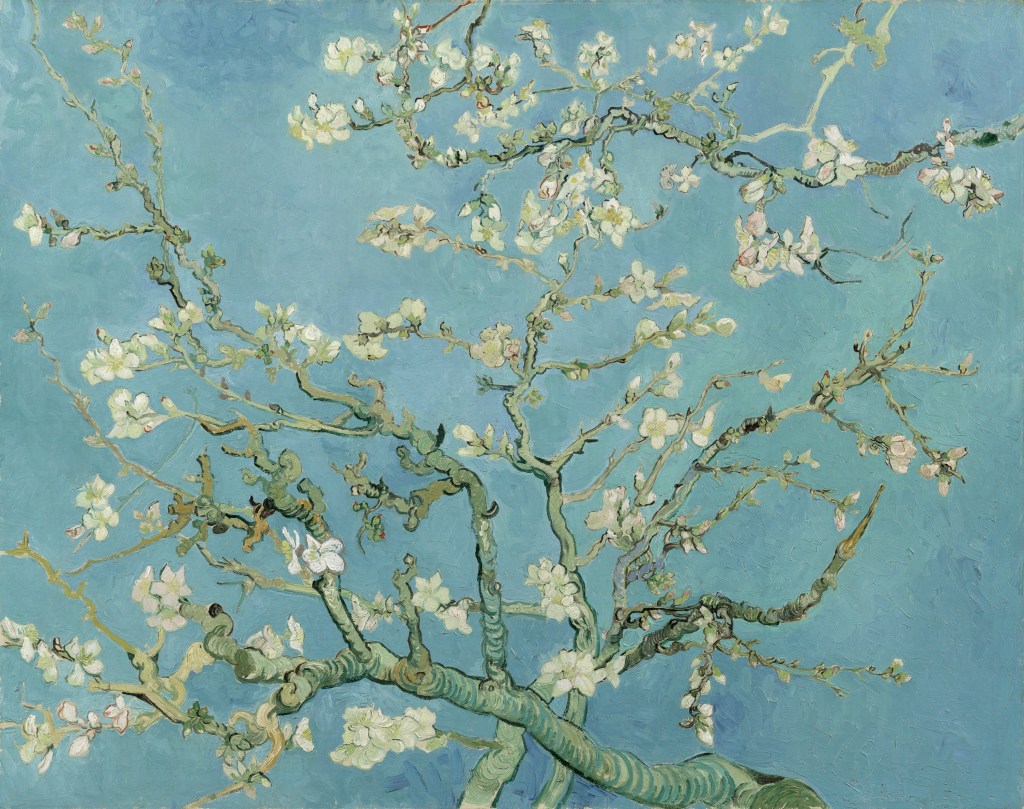
Almond branches are a subject that Van Gogh visited a few times before. In earlier studies, he painted cut branches set in a vase – as a still life. In this picture, Blossoming Almond Tree, for his nephew, he paints a very different composition. Instead of visiting the still life again, he shows white almond tree branches against a blue sky. It is not shown whether these branches are cut from the tree and sitting in a vase outside of the view of the viewer or if they are still on the tree, seen from below looking up towards the sky. It is an unusual composition for both art as a whole and for Van Gogh himself.
Like many of Van Gogh’s paintings, Blossoming Almond Tree has an influence from Japanese prints. Van Gogh collected and admired Japanese artists and used ideas such as bold color, dark outlines, and the beauty of nature in his work. Like pictures by the Japanese artist Hiroshige, Almond Tree shows the branches of a tree against the backdrop of a sky. This Japonismecreates a dynamic and modern composition while still being a recognizably Van Gogh painting.
Van Gogh’s Blossoming Almond Tree, also referred to as Almond Tree, represents much of what Vincent often thought about: rebirth. Trees blooming and flowering announces the beginning of spring and new life. As a gift to celebrate the birth of a child, this could not be more perfect. As soon as Van Gogh found out about the birth, he immediately thought to visit his brother in Paris. Knowing that he was still trying to overcome his mental health issues, he was aware that a trip to a big city could be taxing. He hoped his time in the asylum would enable him to start again, feeling well. He often wrote that he felt better after being in the hospital.
In May of 1890, he was able to leave Saint Paul’s in Saint-Remy and see his family; at this time he brought his painting of the almond tree. Unfortunately, his mental health continued to deteriorate, and he would die less than three months later in the summer of 1890.
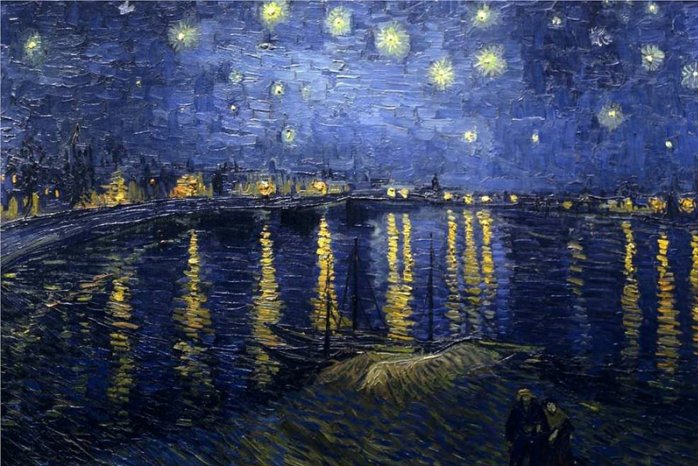
Much like Café Terrace at Night, Van Gogh gathered his paints, canvas, brushes, easel, and chair to find a good spot to paint, only he did it with a gas lamp as well this time. His dedication to his work is evident, not just in the distances he walked or in the conditions he painted. Here it is seen in his words. He carefully details each color used. Color was painting to Van Gogh. Choosing the wrong color would led to the wrong message, the wrong feeling that he wanted to capture. With color, he invited others to share the hours spent painting diligently in his chair. In sharp contrast, Van Gogh barely mentions the couple walking along the edge of the foreground. Humans are not the focus of this piece; they are peripheral. This letter further drives homes that this view of the sky is what he wanted people to see.
Starry Night Over the Rhône does not have the same inviting warmth that Café Terrace at Night carries. By no stretch does this mean that the painting is cold or distant. Instead, it has the feel of a viewer marvelling at the scene before him. As if Van Gogh had opened his arms wide and shouted, “Look at this view! You need to see it!” The figures at the bottom of the right hand corner are small. They nearly blend into the colors of the ground; it’s easy to overlook them on first glance. In doing so, Van Gogh emphasizes how grand and awe-inspiring the sky is. The figures even serve as a contrast to the viewer. Their backs are turned away from looming sky and lamplit city; they have already seen it or don’t care to look. They fail to appreciate the beauty created before them, unlike the viewer who can’t help but to look.
Reflective Note
The emotions are expressed by image has always been one of my research subjects.
“What would you like to do through a tough time?”
“I fear to go through again the road which we walked together but I wanna record the scenery in eyes to show who fade away from my life.”
The self-deception after lost is the way to give a comfort to creator which transforms pain into parts of self through this process.
 The Images Collection