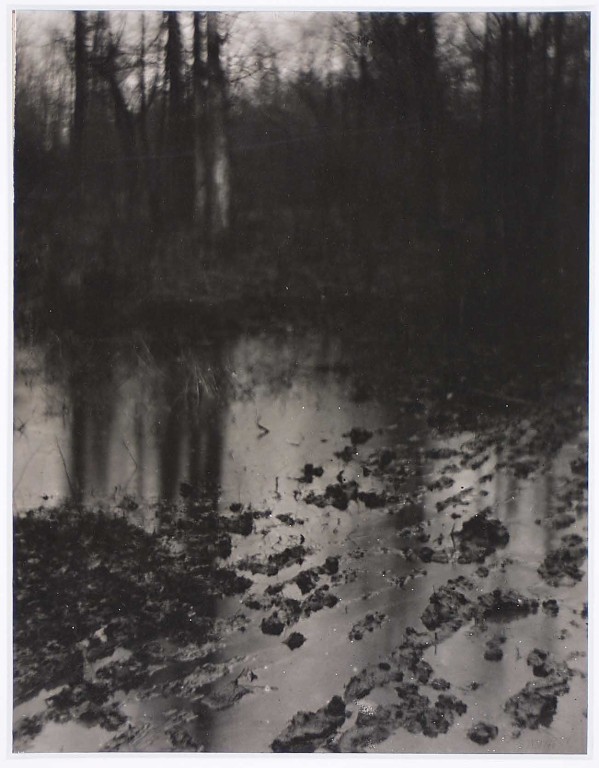
Edward J. Steichen used a plate camera to take this image. He wrote that he focussed on the foreground, which he would have been able to view on the ground glass at the back of the camera. The woods in the background would have been too dark for him to see on the ground glass and so he would have had to estimate at what aperture (the size of the opening through which light passes into the camera) to set the camera in order that the dark background could be seen. The out-of-focus style of the photograph is typical of Steichen’s early work and representative of the suggestive, rather than literal, quality of Photo-Secessionist photography.
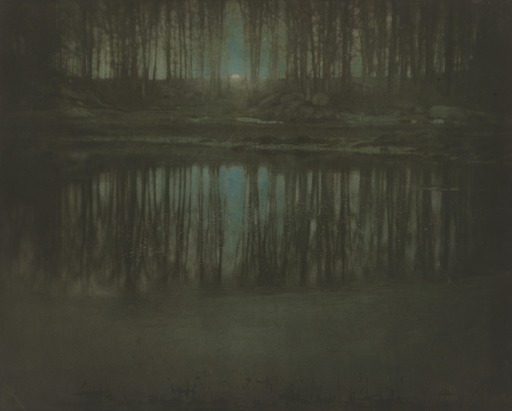
As he headed to Paris to study painting and to see the Rodin Pavilion just outside the 1900 Exposition Universelle, twenty-one-year-old Edward J. Steichen stopped in New York. An aspiring painter and an accomplished photographer in the soft-focus, self-consciously artistic style that distinguished serious amateurs from casual snapshooters and commercial studios alike, Steichen made a pilgrimage to the Camera Club of New York to show his work to Alfred Stieglitz, the leading tastemaker in American photography. Stieglitz, vice-president of the Camera Club and editor of its journal Camera Notes, was impressed by the young artist from Milwaukee and bought three of his photographs—a self-portrait and two moody, atmospheric woodland scenes printed in platinum—for the impressive sum of five dollars each. Elated, Steichen (who told Stieglitz that he’d never before sold a photograph for more than fifty cents) left additional photographs from his portfolio for Stieglitz to publish or send to exhibitions, as he saw fit, and then boarded the ship for Europe.
 The Images Collection